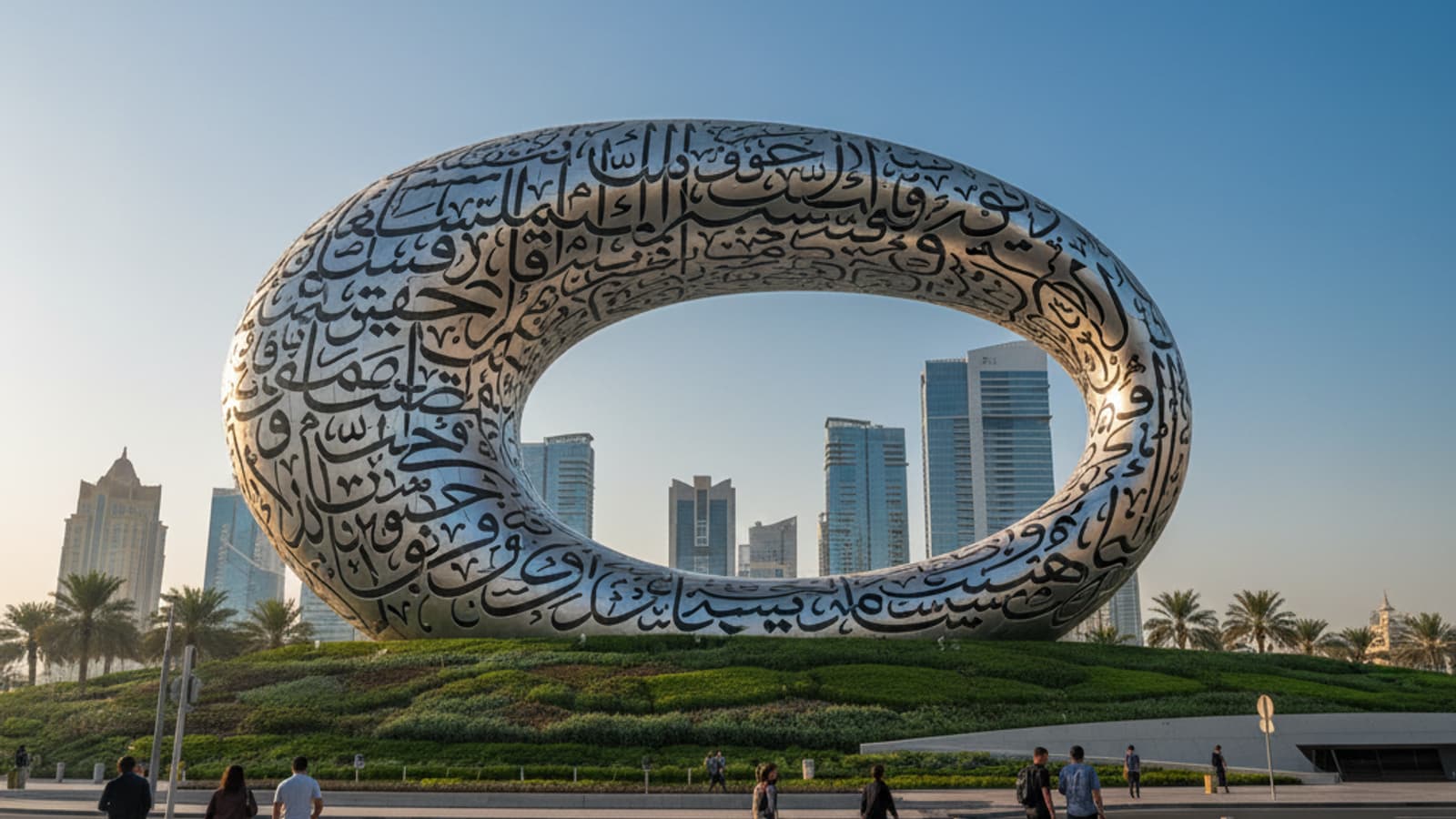
Early morning along Sheikh Zayed Road, the Museum of the Future catches the light differently from every angle. This guide helps travellers move from that first impression to a fully planned visit, covering tickets, timings, transport, and what to expect inside.
Early morning along Sheikh Zayed Road, the Museum of the Future catches the light differently from every angle - its torus form rising above the highway median, Arabic calligraphy pressed into gleaming steel. The city hums around it. This guide exists to help travellers move from that first impression to a fully planned visit, covering tickets, timings, transport, and what to expect inside.
Choosing when to visit the Museum of the Future shapes the experience in ways that go beyond simple crowd management. Queue length at security, natural light conditions for photography outside the building, and the ambient energy inside each exhibition zone all shift meaningfully depending on the season, the day of the week, and the time slot selected. Travellers who plan around these variables consistently report a more rewarding outcome than those who arrive without consideration of them.
Operated by the Dubai Future Foundation, the museum draws a genuinely mixed audience - residents, school groups, international tourists, and design professionals - and the balance of that audience changes considerably across the year. Observed patterns from winter and summer visits suggest real differences in crowd density and atmosphere, details covered in the subsections below.
Important planning notice: The Museum of the Future is temporarily closed as of September 2026 and is expected to reopen in Q1 2027. All seasonal and timing guidance in this article is provided as planning context only. Travellers are strongly advised to confirm current opening status directly with the official Museum of the Future website before making any travel arrangements or ticket purchases.
November through March represents Dubai's peak tourism window. Temperatures during these months typically range from approximately 15C at night to around 26C during the day - conditions that make walking between transport connections and the venue comfortable. The trade-off is higher visitor volume. The Dubai Future Foundation's venue draws significantly more international tourists during this period, and timed-entry tickets for preferred morning slots tend to disappear faster.
Summer visits - roughly June through August - bring a noticeably quieter indoor environment, since the museum is climate-controlled throughout. The challenge is the exterior: temperatures regularly exceed 40C, which matters for travellers arriving on foot or via the metro link bridge. Those who can tolerate the brief outdoor exposure often find the summer visit experience genuinely calmer.
April, May, and October occupy a middle ground: temperatures are moderate, school groups have largely cleared, and ticket availability is generally more flexible. All seasonal guidance here is subject to the temporary closure status; visitors should verify current venue hours directly with the official website before booking.
Prior to the temporary closure, the Museum of the Future operated daily from 9:30 am to 9:00 pm, with last entry accepted at 7:00 pm. These hours are cited here as historical reference and planning context only. All operating hours are subject to change, and visitors are advised to verify directly with the venue upon reopening before booking any time slot.
Based on observed crowd patterns before closure, weekday mornings - particularly Tuesday through Thursday arrivals in the first time slot - tended to offer a noticeably quieter experience than Friday or Saturday afternoons. The last-entry policy at 7:00 pm is worth noting: travellers who plan to arrive in the evening should confirm whether that cut-off remains in place after reopening.
| Day | Time Slot | Expected Crowd Level | Travel Camel Recommendation |
|---|---|---|---|
| Tuesday-Thursday | 9:30 am - 11:00 am | Low to moderate | Recommended for first-time visitors |
| Tuesday-Thursday | 2:00 pm - 4:00 pm | Moderate | Acceptable; slightly busier than morning |
| Friday-Saturday | 9:30 am - 11:00 am | Moderate to high | Book well in advance |
| Friday-Saturday | 2:00 pm - 6:00 pm | High | Avoid if crowd-sensitive |
| Sunday-Monday | Any slot | Low to moderate | Good alternative to midweek |
Crowd levels are approximate and based on observed patterns as of 2026. Hours are subject to change - verify directly with the venue upon reopening.
Arriving at the Museum of the Future, visitors pass through a security screening process that covers both persons and bags. Based on observed visits, this process typically adds between 10 and 20 minutes to arrival time during moderate-traffic periods - longer on busy weekend afternoons. Allowing buffer time before the scheduled slot is a practical necessity, not an abundance of caution.
Once inside, the experience shifts almost immediately into something distinctly immersive. The building's interior is not a conventional gallery space - it is a sequence of environmental chambers, each designed with specific light, sound, and spatial qualities. Some zones use deep directional lighting and ambient audio that fills the room; others open into large, airy spaces with natural-feeling brightness. Visitors with sensory sensitivities will find certain areas - particularly OSS Hope and Al Waha - more intense than a standard exhibition hall.
The Future Heroes zone, designed for children aged 6-11, operates at a noticeably different energy level to the floors above: brighter, louder, and more physically interactive. Families who plan their route with this in mind will navigate the experience more smoothly.
Ticket pricing for the Museum of the Future has been reported in secondary sources at approximately AED 149-169 for a standard adult ticket. This range applies as of 2026 and is presented here as an approximate guide only. All ticket prices are subject to change, and the price confirmed at the time of purchase applies. Travellers should verify current pricing directly via the official Museum of the Future booking platform before making any plans.
Two confirmed pricing policies from official ticket terms are worth noting before anything else: children under 4 years of age enter free of charge, and visitors who hold People of Determination status - along with one accompanying caregiver - also enter free. These policies are confirmed directly by the museum's official ticket terms and conditions.
No general UAE resident free-entry policy is stated here, as this has not been directly confirmed through official sources. Travellers who may be eligible for resident pricing are advised to check current eligibility criteria directly with the venue before booking.
| Ticket Type | Approximate Price (AED, as of 2026) | Inclusions |
|---|---|---|
| Adult | AED 149-169 (verify current pricing) | Full access to all five exhibition zones |
| Child under 4 years | Free | Full access with accompanying adult |
| People of Determination + one caregiver | Free | Full access to all zones |
All prices are subject to change. The price confirmed at the time of purchase applies. Verify current pricing at the official Museum of the Future website before booking.
| Planning Factor | Detail |
|---|---|
| Booking requirement | Timed-entry tickets; advance booking strongly recommended - check official site |
| Recommended visit duration | Approximately 2-3 hours - check official site for current guidance |
| Kids zone | Future Heroes (ages 6-11) - confirm current availability with venue |
| Operator | Dubai Future Foundation |
| Nearest metro access | Emirates Towers Station, Red Line - check official site for current transport guidance |
Official Booking Verification: Tickets for the Museum of the Future are available through the official booking platform at museumofthefuture.ae. Travellers are advised to confirm current pricing, availability, and reopening status directly on the official site before completing any purchase. Travel Camel does not sell tickets and has no commercial relationship with the venue.
Travel Camel's assessment, based on observed visits and the broader range of Dubai cultural attractions, is that the Museum of the Future offers an experience that genuinely stands apart from a conventional museum. The five exhibition zones are not display-case galleries - they are purpose-built environments that use architecture, light, sound, and technology to create something closer to spatial storytelling. For travellers drawn to design, immersive technology, or speculative ideas about the future, the experience is highly likely to deliver on its promise.
Families visiting with children in the 6-11 age range will find the Future Heroes zone purpose-built for that audience. Travellers seeking a quieter, contemplative experience may find certain zones - particularly on busy weekend afternoons - more crowded than ideal.
Operated by the Dubai Future Foundation.
Pros:
Cons:
The Museum of the Future sits alongside Sheikh Zayed Road in the heart of Dubai's financial district, within visual proximity of the Burj Khalifa to the south and the Emirates Towers complex to the immediate north. The address context is straightforward for anyone familiar with this stretch of the city; for those arriving for the first time, the building itself is an unmissable landmark from the road.
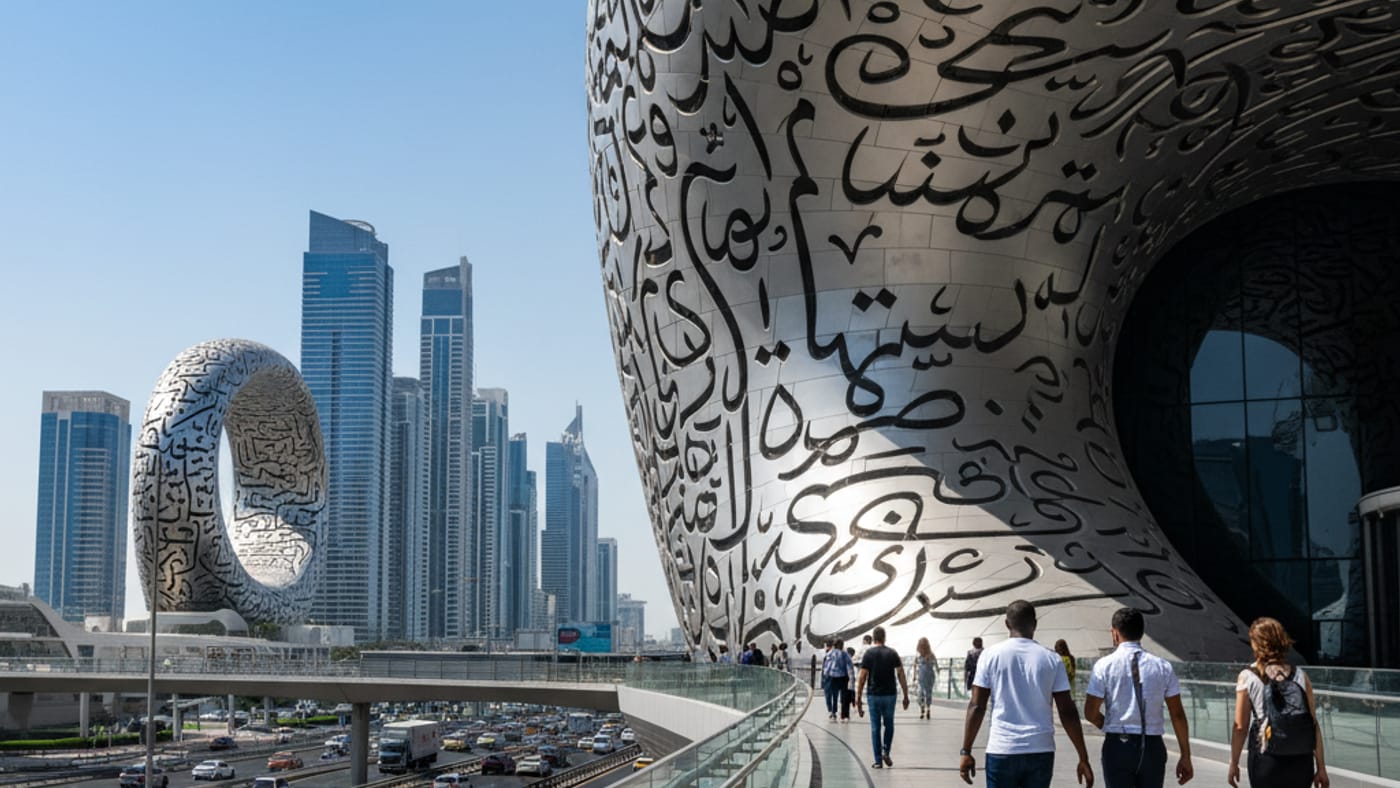
Travellers arriving via the Dubai Metro will find the most convenient access point at Emirates Towers Station on the Red Line. A dedicated covered link bridge - approximately 212 metres in length, confirmed by the Roads and Transport Authority - connects the station directly to the museum entrance, keeping visitors out of the heat for the full walking distance. This connection makes the metro option genuinely practical, not just theoretically convenient.
Travellers arriving by taxi or ride-hailing services should note that Sheikh Zayed Road drop-off logistics can vary; allowing extra time during peak traffic periods is advisable. Driving and self-parking is an option, though the metro route avoids both parking costs and the complexity of navigating the highway interchange.
| Transport Option | Steps | Estimated Time from Station/Drop-off | Notes |
|---|---|---|---|
| Dubai Metro (Red Line) | Board to Emirates Towers Station; follow covered bridge signs | Approx. 5 min walk via covered bridge | Verify current metro schedule via RTA app |
| Taxi / Ride-hailing | Request drop-off on Sheikh Zayed Road near venue entrance | Approx. 2-5 min depending on drop-off point | Verify current road access on live map |
| On foot (from nearby hotels) | Walk along Sheikh Zayed Road; use covered bridge from Emirates Towers | Varies - verify on live map | Not recommended in summer heat without shade route |
Distances and walk times are approximate. Travellers are advised to verify real-time conditions via map applications before visiting.
The Museum of the Future is organised into five distinct exhibition zones, presented in an official visiting sequence confirmed by the Dubai Future Foundation and the venue's own published materials. Zone names are the primary navigational reference - floor numbering varies across public summaries and is best disregarded in favour of the zone titles.
Families planning a visit to the Museum of the Future will find the experience genuinely accommodating for children, with one zone - Future Heroes - specifically designed for visitors aged 6-11. This is the primary family planning anchor for the venue, offering interactive, hands-on content that sits apart from the more contemplative adult zones above it.
Two age-related policies are confirmed in the official ticket terms and conditions: children aged 15 and under must be accompanied by a parent or guardian who is over 21 years of age, and children aged 16 and older may enter independently. Families travelling with teenagers across this age boundary should confirm the current policy directly with the venue before booking.
Stroller accessibility within the venue has been reported as generally accessible in third-party listings, though the specific configuration of some exhibition zones may present practical considerations. Travellers who rely on strollers are advised to confirm current accessibility arrangements directly with the museum before visiting. Seating areas within the venue are available, based on observed visits, though specific rest area locations should be confirmed on-site.
Most visitors spend approximately 2-3 hours moving through all five exhibition zones. Faster-paced visitors - particularly those revisiting the museum or those less engaged with interactive elements - have completed the experience in 90-120 minutes. Families with children in the Future Heroes zone will typically find that additional time improves the experience, as the zone rewards engagement rather than a quick pass-through.
Entry to the museum is timed-slot based. No official source confirmed a strict internal time limit once visitors are inside, so the duration figures here reflect observed pace patterns rather than any enforced cap.
The approximate time splits below are offered as a planning guide only, labelled as estimates for 2026 visits:
| Visit Type | OSS Hope | The Heal Institute | Al Waha | Tomorrow Today | Future Heroes | Total |
|---|---|---|---|---|---|---|
| Quick visit | 15 min | 15 min | 10 min | 20 min | 15 min | ~75-90 min |
| Full visit | 25 min | 25 min | 20 min | 30 min | 20 min | ~2-2.5 hrs |
| Family visit (with children) | 25 min | 20 min | 15 min | 25 min | 40 min | ~2.5-3 hrs |
All time estimates are approximate guides as of 2026. Pace varies significantly between visitor types.
Preparing well for a Museum of the Future visit is straightforward, but a few specifics make a material difference to the experience on the day.
Several patterns emerge consistently among first-time visitors to the Museum of the Future. Each is avoidable with straightforward advance planning.
The Museum of the Future is one of a small number of built environments in the world that genuinely delivers something different from the category it nominally belongs to. Operated by the Dubai Future Foundation, it uses architecture, immersive design, and sequential spatial storytelling to create an experience that sits outside the standard cultural attraction template. Those who arrive with a little planning - an early booking, a weekday morning slot, comfortable shoes, and a charged device - consistently find the visit more rewarding than those who arrive unprepared.
The museum is temporarily closed as of September 2026 and is expected to reopen in Q1 2027. Travel Camel encourages all prospective visitors to monitor the official Museum of the Future website for current availability, confirmed reopening dates, and updated ticket pricing before finalising any travel plans. Those who plan ahead will find the experience well worth the preparation.
Tickets and current availability can be checked directly at the official Museum of the Future booking page: museumofthefuture.ae. For further help, see the Museum of the Future FAQ.
Last verified: Timings, pricing, and transport information accurate as of 2026. All details subject to change - verify directly with the venue before visiting.
Adult tickets have been reported at approximately AED 149-169 based on secondary sources as of 2026, though all prices are subject to change - travellers should verify current pricing on the official Museum of the Future website. Children under 4 enter free, and People of Determination plus one accompanying caregiver also enter free, as confirmed by official ticket terms. Note that the museum is temporarily closed as of September 2026, with an expected reopening in Q1 2027.
Advance booking through the official Museum of the Future website is strongly recommended. Popular time slots - particularly weekday mornings - sell out well ahead of the visit date. Whether tickets are available for purchase on-site at the door is not confirmed in official sources; travellers should check current ticket availability and purchase options directly with the venue before arriving without a reservation.
Travel Camel's assessment is that the Museum of the Future, operated by the Dubai Future Foundation, offers a genuinely distinctive experience - five immersive exhibition zones that go well beyond conventional gallery formats. Travellers interested in design, technology, or speculative futures are likely to find it highly rewarding. Families with children aged 6-11 benefit from the dedicated Future Heroes zone. The experience justifies the ticket price for most visitor profiles, though those seeking a quieter environment should choose weekday mornings.
The nearest metro station is Emirates Towers Station on the Dubai Metro Red Line. A dedicated covered link bridge of approximately 212 metres connects the station directly to the museum entrance, confirmed by the Roads and Transport Authority. This makes the metro one of the most practical arrival options available, keeping visitors protected from the outdoor heat for the full walking distance from the platform.
Most visitors spend approximately 2-3 hours moving through all five exhibition zones, though faster-paced visitors have completed the experience in 90-120 minutes. Families with children who engage fully with the Future Heroes zone will typically need closer to 2.5-3 hours. These are estimates based on observed visit patterns as of 2026; travellers should plan itineraries with flexibility around these approximate figures.
The Museum of the Future includes the Future Heroes zone, officially designated for children aged 6-11, offering interactive and physically engaging content designed specifically for that age group. Children aged 15 and under must be accompanied by a parent or guardian over 21; children aged 16 and older may enter independently, as confirmed by official ticket terms. Families are advised to confirm current child ticket pricing, age policies, and zone availability directly with the venue before booking.
Official ticket terms and conditions require visitors to arrive at least 15 minutes before their scheduled entry time. No refund is offered if the arrival time slot is missed. Travellers are advised to treat the scheduled entry time as a firm deadline and plan transport accordingly, allowing extra time for security screening on arrival. The late-arrival policy applies regardless of the reason for delay, so building in buffer time is a straightforward way to protect the booking.
Get an instant summary or ask follow-up questions about this article in your favourite assistant.

UAE Editor at TravelCamel
Daniel moved to Dubai in 2016 and covers attractions, transport and day trips across all seven emirates. His rule for every guide: if a place is not worth the ticket, the guide says so. More guides by Daniel →