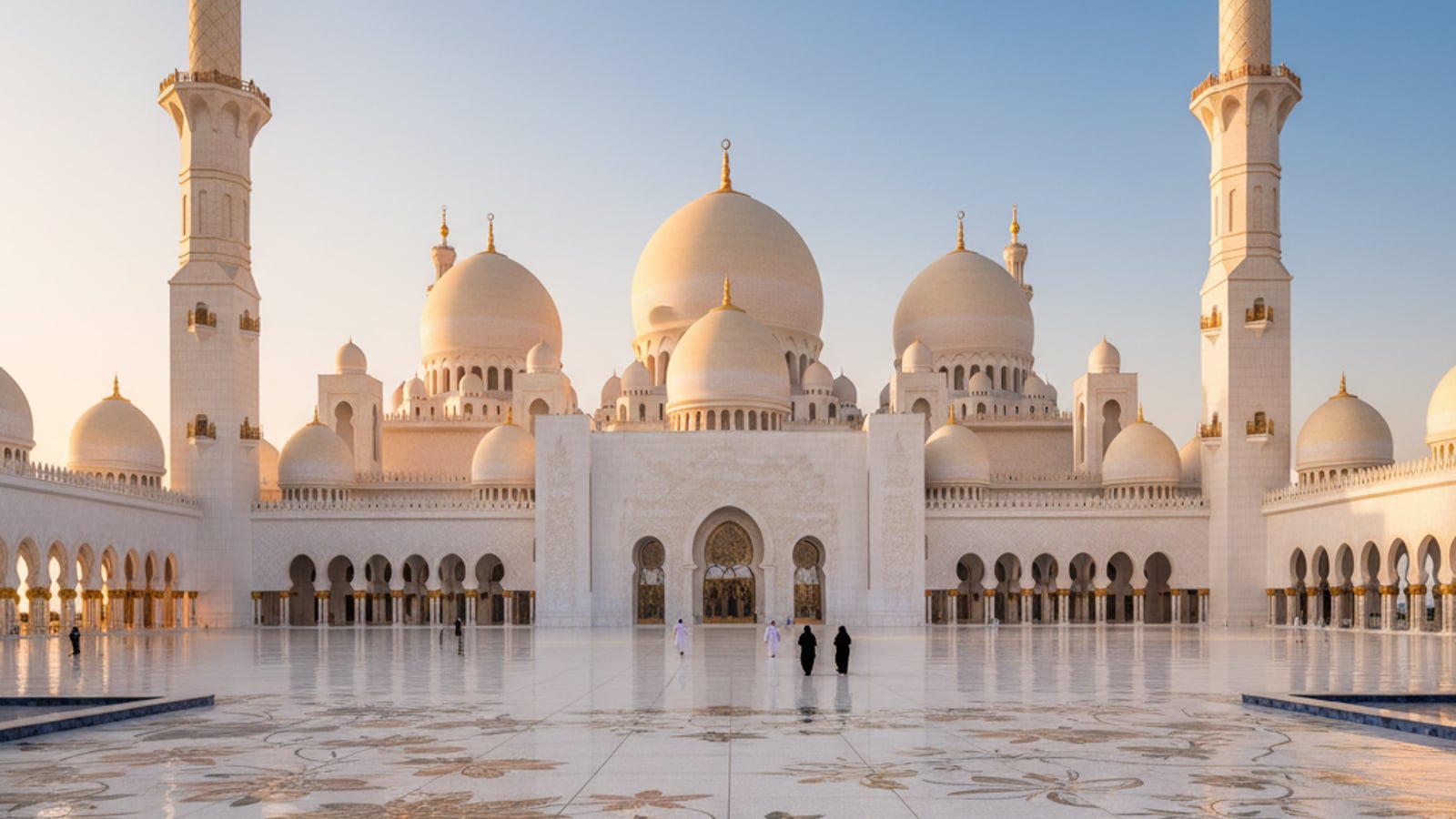
Everything a first-time visitor needs for the Sheikh Zayed Grand Mosque in Abu Dhabi: opening hours, dress code, online access passes, tours, prayer times, transport from Dubai and the architectural details worth pausing for.
Few buildings in the United Arab Emirates stop visitors in their tracks the way the Sheikh Zayed Grand Mosque does. Situated in Abu Dhabi, it is widely regarded as the largest mosque in the UAE and stands as one of the largest mosques in the world - a distinction the official Sheikh Zayed Grand Mosque Centre attributes to the site on its own pages. The mosque can accommodate approximately 55,000 worshippers at capacity, with the main prayer hall alone holding around 7,800 people and two additional prayer halls accommodating approximately 1,500 each, according to szgmc.gov.ae.
Administered by the General Authority of Islamic Affairs and Endowments (Awqaf), the mosque operates as a fully functioning place of worship, not simply an architectural landmark open for tourism. That distinction matters. Layla Haddad-Rennick, whose decade of travel across the Emirates informs much of Travel Camel's coverage of the region, notes that the mosque carries a weight that many other Gulf landmarks do not - a living quality that separates it from monuments designed purely for spectacle.
Commissioned in memory of the late Sheikh Zayed bin Sultan Al Nahyan, founder of the UAE, the mosque holds a deep connection to the House of Nahyan. Mohamed bin Zayed Al Nahyan, the current President of the UAE, has maintained that association. For Abu Dhabi tourism, it represents the city's most visited cultural site and an enduring symbol of Islamic architecture at its most ambitious.
On any given morning, before the tour groups assemble near Gate 6, worshippers have already filled quiet corners of the prayer halls. A man adjusts his prayer mat near the far wall. A family waits near the entrance of the women's section. The Sheikh Zayed Grand Mosque holds both realities at once - the reverence of an active mosque and the openness of a site that welcomes curious visitors from every part of the world.
Friday prayer gives the week its rhythm here. Each Friday, an Imam leads the congregational Dhuhr prayer, drawing worshippers from across Abu Dhabi. The closure of visitor access during the Friday midday window is not a logistical inconvenience - it is simply the mosque being what it has always been: a place of worship first.
That dual identity is, for many visitors, the most striking thing about it. The marble corridors carry the echo of footsteps from both pilgrims and photographers, and neither presence diminishes the other.
Visitor hours at the Sheikh Zayed Grand Mosque follow a consistent weekly pattern, with one significant variation on Fridays to accommodate congregational prayer. Knowing this structure before you book travel from Dubai - or plan a full day in Abu Dhabi - saves considerable frustration at the gate.
Saturday through Thursday, the mosque is open to visitors from 9:00 AM to 8:30 PM. On Fridays, visitor access runs from 9:00 AM to 11:30 AM, then resumes at 2:30 PM and continues until 8:30 PM. The midday closure exists because Friday prayer is the week's most significant congregational moment at the mosque, led by the Imam with worshippers filling the main hall. Travel Camel advises building a buffer around that window - arriving before 10:30 AM or planning to enter after 3:00 PM on a Friday tends to give visitors a smoother start.
During Ramadan, the schedule shifts considerably. In the first twenty days of the holy month, the mosque is open daily from 9:00 AM to 6:00 PM and again from 9:30 PM to 1:00 AM, with Friday hours running 2:30 PM to 6:00 PM and 9:30 PM to 1:00 AM. During the final ten days of Ramadan, daily hours are 9:00 AM to 6:00 PM, and Friday hours follow the same 2:30 PM to 6:00 PM pattern.
All times are sourced from szgmc.gov.ae and are subject to change. The team at Travel Camel strongly recommends verifying the current schedule directly with the official mosque website or the Abu Dhabi tourism authority before travelling, particularly around public holidays and religious observances.
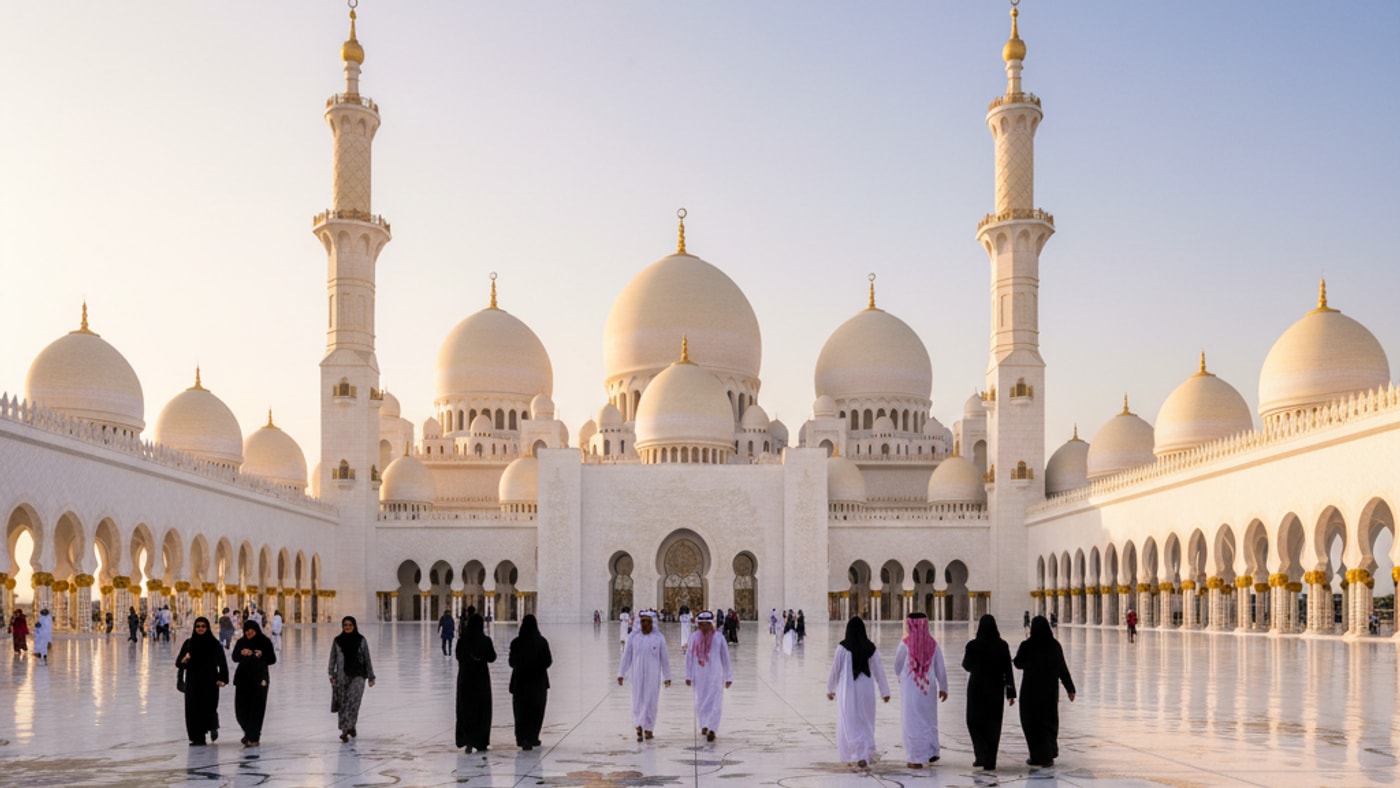
Arriving in the late afternoon - an hour or so before sunset - gives visitors something the midday crowds rarely see. As the light drops behind Abu Dhabi's skyline, the white marble of the mosque's exterior begins to shift. The reflective pools in the outer courtyard pick up the last of the sun, and the 82 domes and four minarets gradually lose their sharp edges against a darkening sky.
Once the exterior lighting activates - typically shortly after sunset, though exact timing varies by season - the effect across the domes and minarets is considered by many visitors to be the defining view of the site. The team at Travel Camel suggests positioning yourself near the outer colonnades, facing the main facade, to capture both the illuminated structure and its reflection in the pools below. A wide-angle lens helps, but the view rewards even a smartphone camera if the light conditions cooperate.
Here is a detail that most visitor guides overlook entirely. The Sheikh Zayed Grand Mosque's exterior illumination does not remain constant - it shifts across the Hijri month in response to the moon's phase and position. At the new moon, the light cast across the domes tends toward cooler, dimmer tones. As the month progresses toward the full moon, the illumination brightens and warms, reaching its peak intensity when the lunar light itself is strongest. This system is documented on the official SZGMC site and in the mosque's published visitor guide, The Moon Has a Story... Told by Light. If your travel dates allow any flexibility, timing your evening visit to coincide with the full moon period gives the domes their most striking appearance.
The Sheikh Zayed Grand Mosque asks visitors to dress modestly, and the requirements are specific enough that arriving unprepared can mean being redirected at the entrance - something the team at Travel Camel has observed more than once. A visitor in shorts and a sleeveless top, arriving confident and camera-ready, is asked to step aside and collect alternative clothing before entering. That brief delay is entirely avoidable.
The official dress code, sourced directly from szgmc.gov.ae, is as follows:
For visitors who arrive without compliant clothing, the mosque provides an abaya service at the entrance. Whether this service is currently complimentary or carries a charge could not be confirmed from official sources at the time of writing - readers should verify current availability and any associated cost directly with szgmc.gov.ae before travelling. What the mosque's official guidance does confirm is that the service exists. Treating the dress code as an expression of respect for the site's identity, rather than an inconvenience, makes the whole experience more rewarding from the moment you step through the gate.
Entry to the Sheikh Zayed Grand Mosque is not free for visitors, and an online access pass is required before arriving at the gate. Getting this step right before you travel removes the most common source of anxiety for first-timers.
The fee structure, as published on the official SZGMC portal, is as follows: AED 10 for visitors from outside the UAE, AED 8 for visitors arriving through a tour operator, and AED 5 for holders of an Emirates ID. Worshippers enter the mosque free of charge without an entry ticket - a distinction the mosque makes clearly, both in its published guidance and in its physical layout.
Visitors and worshippers use separate entry points. Visitors enter via Gate No. 6, the visitor centre, and Entrance 2. Worshippers arrive through Souq Al Jami' and the Tolerance Path. The two pathways run in parallel and reflect the mosque's dual identity as an open cultural destination and an active place of worship.
To book an online access pass, the step-by-step process via szgmc.gov.ae runs as follows:
All pass availability is subject to change. Travel Camel advises confirming current availability directly with the mosque portal before finalising travel plans, particularly around Ramadan, public holidays, and Friday prayer windows when access hours differ.
Once entry is secured, visitors face a second decision: how to move through the mosque. Three options are available, and the right choice depends largely on what kind of visitor you are.
The five daily prayers - Fajr, Dhuhr, Asr, Maghrib, and Isha - give the Sheikh Zayed Grand Mosque its daily rhythm. As a fully functioning mosque, the site observes these prayer times throughout the year, and the timings shift seasonally as sunrise and sunset move. The official SZGMC website publishes current daily prayer times, and checking them before your visit is worth the two minutes it takes.
What is confirmed from official sources is that Friday visitor hours run from 9:00 AM to 11:30 AM and from 2:30 PM to 8:30 PM, with the midday closure reflecting the week's most significant congregational prayer. Whether visitor access adjusts during all five daily prayers on other days of the week is not definitively stated in the mosque's published guidance - Travel Camel advises readers to check current visitor protocols directly with szgmc.gov.ae rather than assuming a blanket rule applies.
Planning a Friday visit with a buffer of 30 to 45 minutes before the 11:30 AM closure, or arriving well after 2:30 PM, is a practical approach the team at Travel Camel suggests - not as a guarantee of smooth entry, but as a reasonable way to work with the mosque's weekly rhythm rather than against it.
Salah - the Arabic term for the five daily prayers - is one of Islam's five pillars, practiced by Muslims worldwide as an act of direct connection between the worshipper and God. At the Sheikh Zayed Grand Mosque, that practice is visible and present. It is not a historical exhibit. When the Imam leads congregational prayer on a Friday, the main hall fills with worshippers facing the Qibla - the direction oriented toward Mecca - and the act of prayer becomes the most prominent event in the building.
For visitors, understanding this provides useful context. The prayer schedule is not a logistical variable imposed on the visitor experience. It is the heartbeat of the building itself. Knowing why access adjusts around prayer times makes it easier to receive that adjustment as what it is - a moment to step back, observe quietly, and understand a little more about the place you are standing in.
When the Adhan sounds across the courtyard, the effect is immediate. The call rises from the mosque's four minarets - each one over 100 metres tall - and carries across the reflective pools and marble walkways in a way that the architecture seems designed to amplify. Conversations pause. Footsteps slow. The sound fills the open space in a way that is difficult to describe accurately in advance.
Visitors who hear the Adhan during their time at the mosque are encouraged to lower their voices, move quietly to the edges of communal spaces, and allow worshippers to move toward the prayer halls without obstruction. This is not a formal instruction so much as natural, considerate behaviour. The Adhan is, for many visitors, the moment that makes the mosque feel most fully itself - a living place rather than a stage set - and meeting it with quiet attention rather than continued activity says more about a visitor's engagement with the site than any photograph.
The mosque sits in Abu Dhabi, approximately 130 to 140 kilometres from central Dubai via the E11 / Sheikh Zayed Road corridor. Under clear to moderate traffic conditions, that translates to roughly 75 to 120 minutes of driving - though anyone who has travelled the E11 on a Friday afternoon will know that traffic can extend that figure considerably. The team at Travel Camel treats all journey time estimates as ranges, not promises.
All cost and time figures are approximate and sourced from third-party travel resources. Readers should verify current fares and schedules with official transport providers in the UAE before finalising plans.
The exterior of the Sheikh Zayed Grand Mosque prepares you, partially. What it does not fully prepare you for is the threshold moment - stepping from the outer courtyard into the main prayer hall and encountering the full scale of the interior at once.
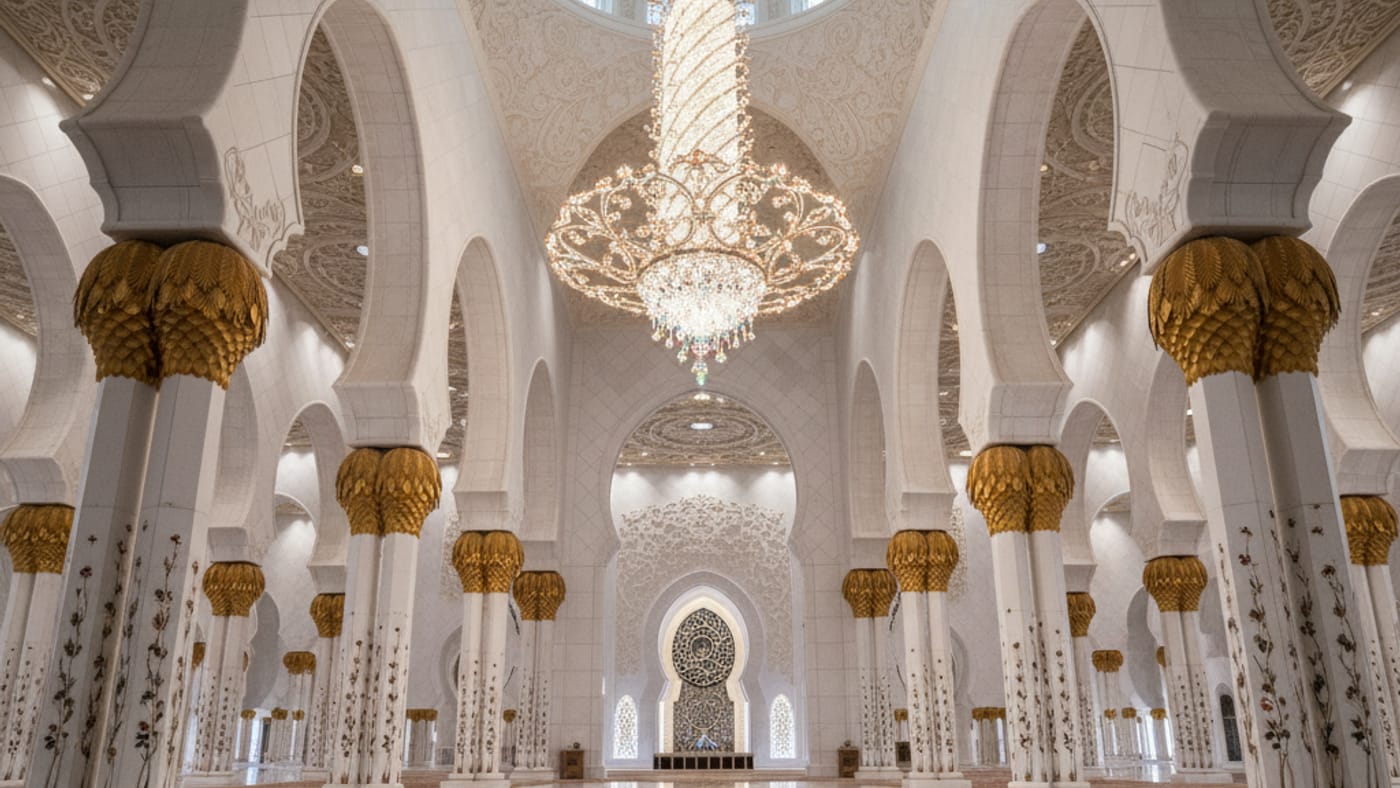
The hall is defined by its chandelier, made by the German lighting manufacturer Faustig and incorporating Swarovski crystals. The largest measures 12 metres in diameter and 15.5 metres in height, figures confirmed by the official SZGMC architectural documentation. Standing beneath it, the scale is not abstract - it is physically present in a way that photographs consistently underrepresent.
Underfoot, the hand-knotted carpet extends across approximately 5,700 square metres of the main prayer hall floor, widely described as the world's largest hand-knotted carpet. The pattern is intricate, though the full composition only resolves from elevation - from the balcony level, the geometric structure becomes visible in a way that ground level does not allow. The mosque's 82 domes and 1,096 exterior columns complete the structural picture, with the columns' white marble sourced from multiple countries, a detail the SZGMC architectural pages document in full.
For photography, the colonnaded walkways along the outer courtyard offer consistent framing at most times of day. The reflection pools, when calm, give the main facade a symmetry that is worth the patience of waiting for foot traffic to clear.
Most difficulties first-time visitors encounter at the Sheikh Zayed Grand Mosque are preventable. The team at Travel Camel has observed the same patterns repeat often enough to be worth addressing directly.
A visit to the Sheikh Zayed Grand Mosque rewards preparation. The building itself does the rest.
Visitor entry is not free. Fees are AED 10 for international visitors, AED 8 for tour operator visitors, and AED 5 for Emirates ID holders. An online access pass must be booked in advance via szgmc.gov.ae. Worshippers enter free of charge without an entry ticket. Confirm current fees directly with the official mosque website before travelling.
Women are required to wear loose-fitting attire covering ankles and wrists, with full hair coverage and no transparent or tight clothing. Men should cover their legs fully and avoid sleeveless or tight-fitting shirts. These requirements are confirmed on szgmc.gov.ae. Arriving dressed appropriately prevents delays at the entrance.
Saturday to Thursday: 9:00 AM to 8:30 PM. Friday: 9:00 AM to 11:30 AM and 2:30 PM to 8:30 PM. Ramadan hours differ significantly. All times are sourced from szgmc.gov.ae and are subject to change - confirm current hours directly with the mosque before travelling.
An abaya service is available on-site for visitors who arrive without compliant clothing. Whether this service is currently provided free of charge or at a cost could not be confirmed from official sources at time of writing. Travel Camel advises verifying current availability and any charge directly with szgmc.gov.ae before your visit.
The most direct route is via the E11 / Sheikh Zayed Road, approximately 130 to 140 km, with typical driving times of 75 to 120 minutes in reasonable traffic. Taxis cost approximately AED 185 to AED 350 one way. Public buses are available for approximately AED 10 to AED 25. Confirm all fares and schedules with official transport providers before travelling.
Late afternoon to early evening tends to offer cooler temperatures, softer light on the marble exterior, and the opportunity to stay for the illuminated night view. Weekday mornings are generally quieter than weekends. Arriving well before the Friday midday closure, or after 2:30 PM on Fridays, helps visitors work with the prayer schedule. No visit time can be guaranteed crowd-free.
Yes. Worshippers enter directly via Souq Al Jami' and the Tolerance Path without an online access pass and without charge. The visitor entry process - via Gate No. 6 and the visitor centre - is a separate pathway. This distinction is confirmed on the official SZGMC booking and FAQ pages at szgmc.gov.ae.
Get an instant summary or ask follow-up questions about this article in your favourite assistant.

UAE Editor at TravelCamel
Daniel moved to Dubai in 2016 and covers attractions, transport and day trips across all seven emirates. His rule for every guide: if a place is not worth the ticket, the guide says so. More guides by Daniel →