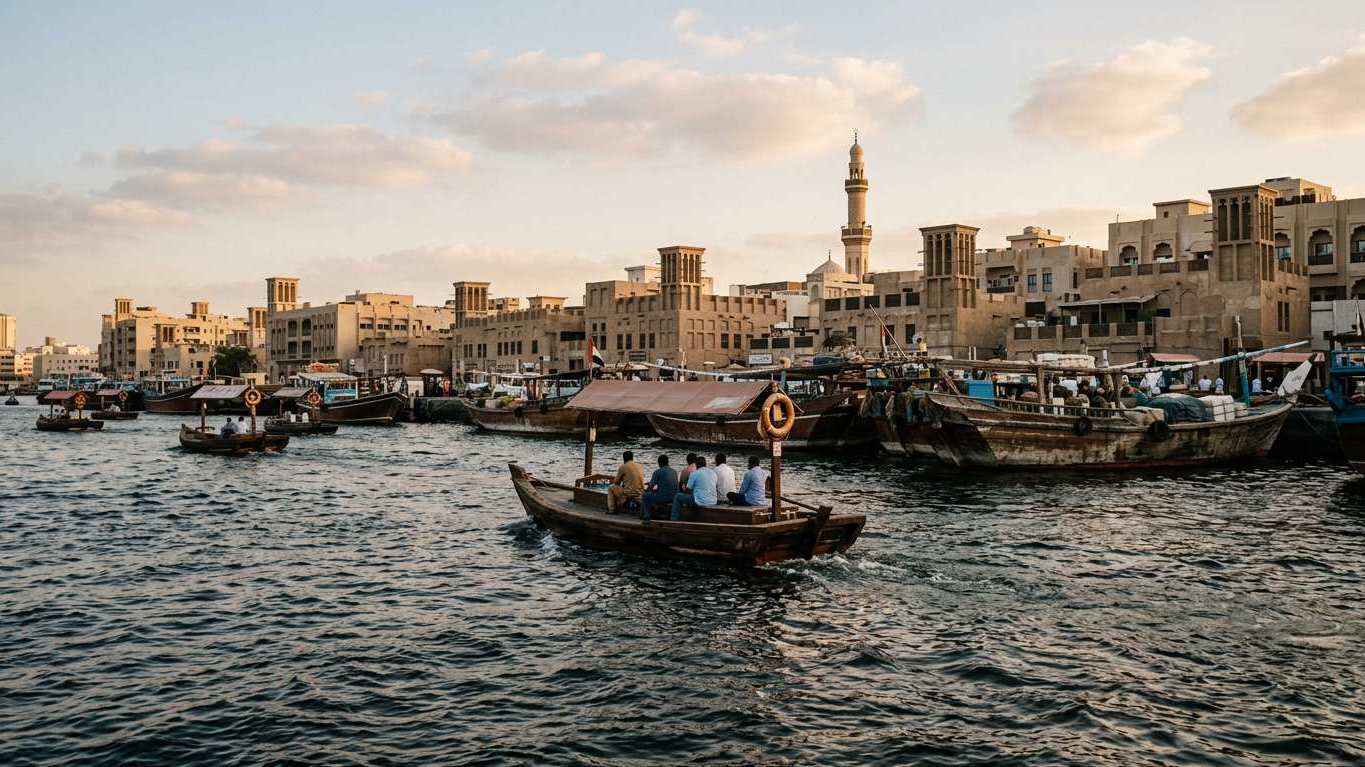
Most first-time visitors spend their days in Downtown and the Marina, then fly home thinking Dubai is thirty years old. It is not. The city started on a saltwater inlet a few kilometres inland, and that inlet is still there, still working, and still the most interesting half-day in Dubai for anyone who wants more than glass towers. This guide walks you through it in the order that makes sense on the ground.
Old Dubai is not one place. Dubai Creek divides the historic city into two banks, and everything worth seeing sits on one side or the other.
On the southern bank is Bur Dubai: the Al Fahidi Historical Neighbourhood, the Textile Souk and the old fort. On the northern bank is Deira: the Gold Souk, the Spice Souk and the cargo wharves where wooden dhows still load televisions and car tyres bound for Iran and East Africa.
The two banks are linked by abras, small wooden water taxis that have been crossing the creek since long before the bridges existed. That crossing is the spine of any visit, and it is what makes the area walkable in a single morning.
The order matters. Start on the Bur Dubai side in the morning while the lanes are still shaded, cross the creek in the middle of the day, and finish in Deira among the souks. This route runs roughly four hours at a comfortable pace, including stops.
| # | Stop | What it is | Time to spend |
|---|---|---|---|
| 1 | Al Fahidi metro station | Green Line, your starting point | - |
| 2 | Al Fahidi Historical Neighbourhood | Restored wind-tower quarter, galleries, cafes | 45-60 min |
| 3 | Al Fahidi Fort | The city's oldest building, home of Dubai Museum | 20 min |
| 4 | Textile Souk | Covered arcade of fabric and souvenir stalls | 20 min |
| 5 | Bur Dubai abra station | Cross the creek by water taxi | 10 min |
| 6 | Deira Old Souk | Lands you directly in the old market district | 15 min |
| 7 | Spice Souk | Saffron, frankincense, dried lemons | 20-30 min |
| 8 | Gold Souk | Roughly 300 jewellers on one street | 30-45 min |
| 9 | Al Ras metro station | Green Line, five minutes' walk out | - |
Walk it in reverse if you are starting from Deira. The one thing not to do is attempt it between noon and four in the afternoon in summer, when the heat is punishing and half the souk shutters are down anyway.
Al Fahidi, still widely called Bastakiya, was built at the end of the nineteenth century by Persian merchants from the town of Bastak, who were offered tax concessions to trade from Dubai. They built in coral stone and gypsum, and topped their houses with barjeel, the square wind towers that catch any breeze and funnel it down into the rooms below. Before electricity, that was the air conditioning.
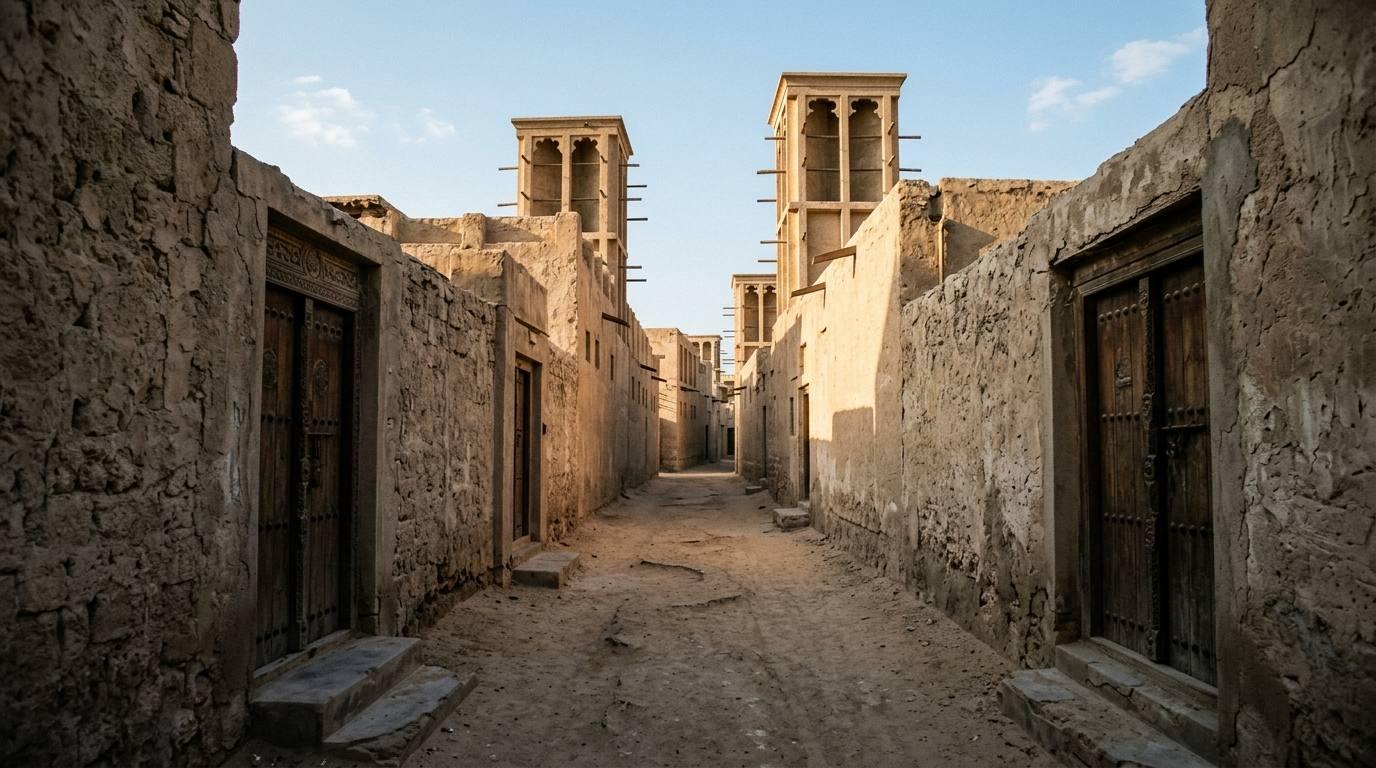
The lanes are narrow, sand-coloured and deliberately confusing, and the whole quarter takes maybe forty-five minutes to wander properly. It is free to walk through. What fills the time are the things tucked inside the courtyards: small art galleries, the Coffee Museum, a couple of quiet cafes serving karak, and the Sheikh Mohammed Centre for Cultural Understanding, which runs sit-down cultural meals where you can ask an Emirati host the questions you would not ask a stranger. Those meals need booking ahead and are one of the few genuinely useful cultural experiences a tourist can buy in this city.
Al Fahidi Fort, at the edge of the quarter, is the oldest surviving building in Dubai and houses the Dubai Museum. The museum has been closed for an extended renovation, so check its current status before you plan around it rather than assuming the doors are open.
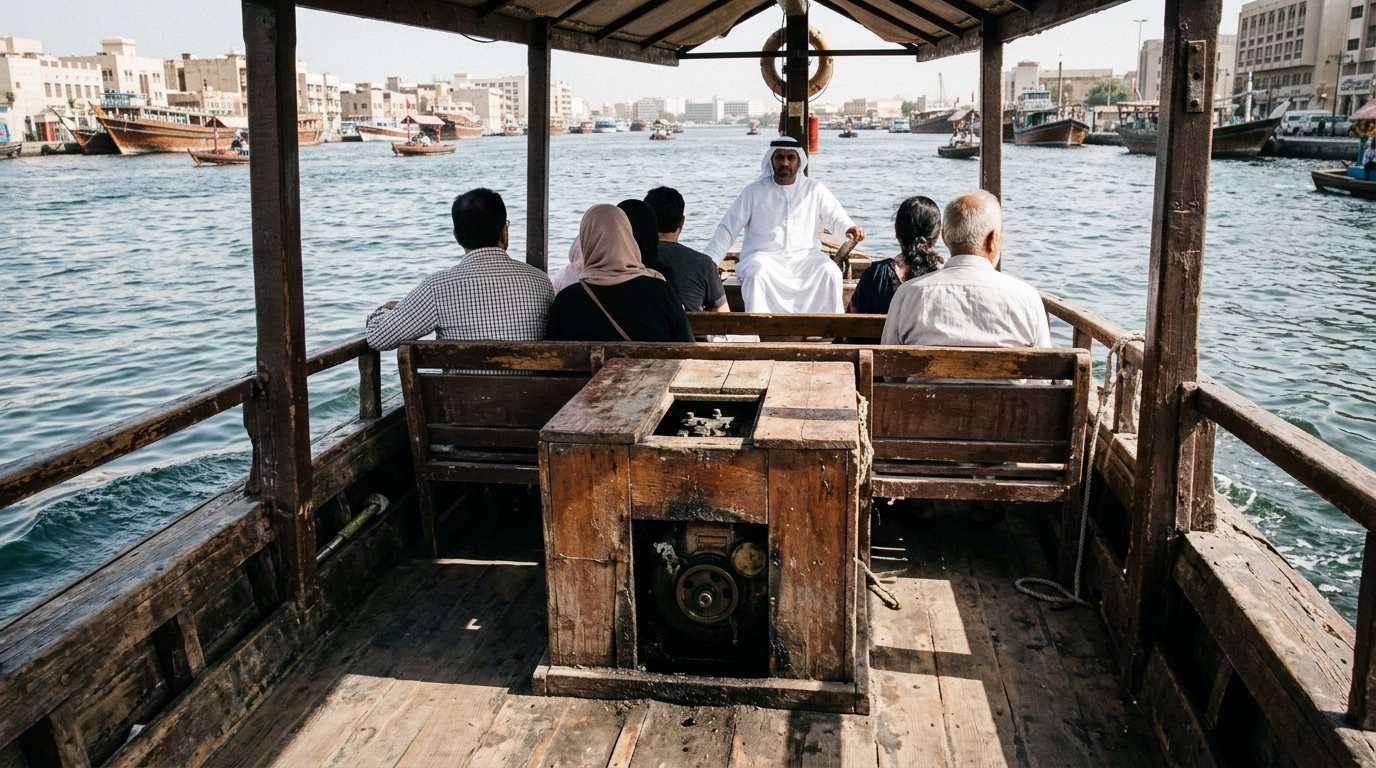
An abra crosses Dubai Creek in about five minutes and costs AED 1, paid in cash to the skipper somewhere in the middle of the water. There is no schedule and no ticket office. Boats leave when the benches fill, which in practice means every few minutes.
| Route | From | To | Fare |
|---|---|---|---|
| Route 1 | Bur Dubai station | Al Sabkha (Deira) | AED 1 |
| Route 2 | Dubai Old Souk station | Al Sabkha (Deira) | AED 1 |
| Charter | Any station | Wherever you like | Hourly rate, agreed up front |
For a straight crossing, take the scheduled abra and sit on the outside bench. If you want the longer view of the waterfront, hire a whole boat by the hour and agree the price before you step aboard. The evening dhow dinner cruises are a different product entirely: slower, air-conditioned, aimed squarely at tour groups, and worth it only if the meal matters more to you than the crossing.
The creek at dusk, with the wooden cargo dhows moored three deep and the call to prayer coming off both banks, is the single best free thing to do in Dubai. That is not a figure of speech: it costs one dirham.
The Gold Souk sits on Sikkat Al Khail Street in Deira, a covered lane of roughly three hundred jewellers with windows stacked so densely that the light in the street turns yellow. It is a working market, not an exhibit, and the first thing to understand is how the price works.
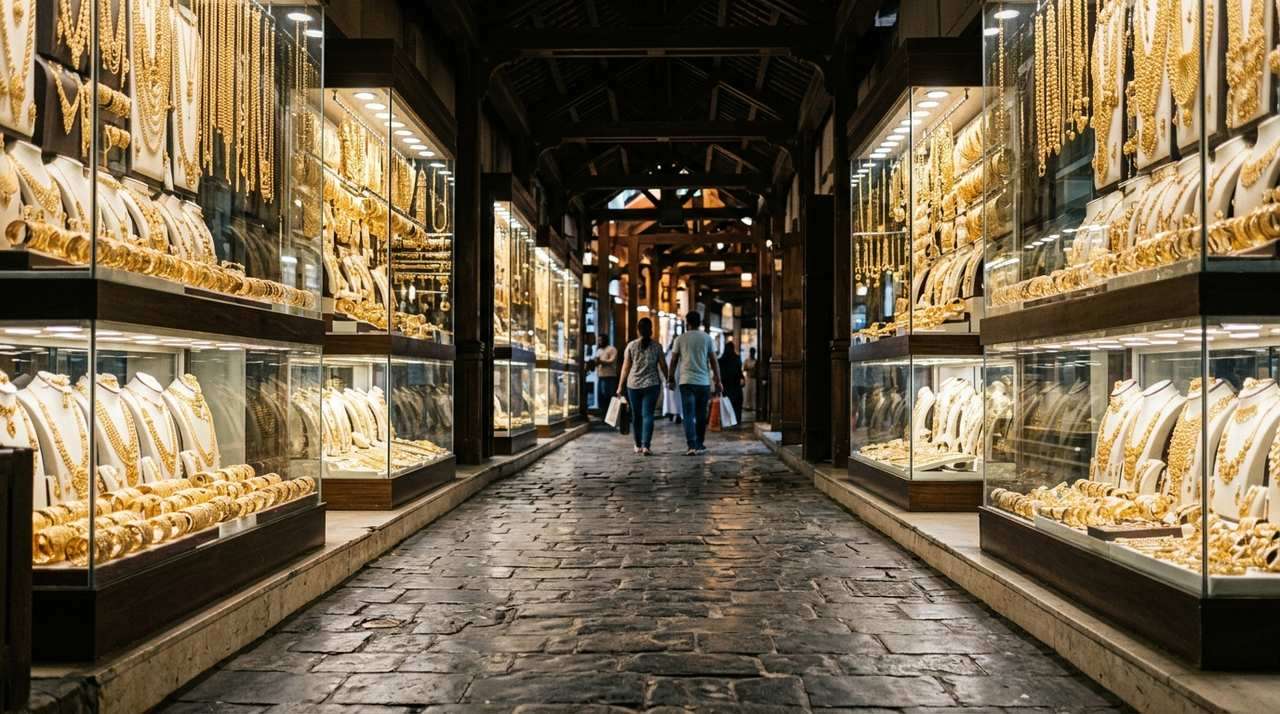
Gold in the UAE is sold at a daily rate per gram, published each morning and the same in every shop. The metal itself is not negotiable. What you are haggling over is the making charge, the shop's fee for the craftsmanship, which is where the margin lives and where a firm, polite negotiation can save you real money. If a seller offers a discount on the gold itself, that is a sign to walk away.
Practical notes:
Is gold actually cheaper here? The metal is priced globally, so the saving comes from low duty and thin making charges rather than magic. For plain, heavy pieces the difference against European prices is real. For intricate designer work it usually is not.
The Spice Souk lies a short walk from the Deira Old Souk abra station, a compact grid of open sacks: saffron, dried lemons, frankincense, za'atar, rose buds, nuts and every kind of dried fruit. It is smaller than photographs suggest and takes half an hour.
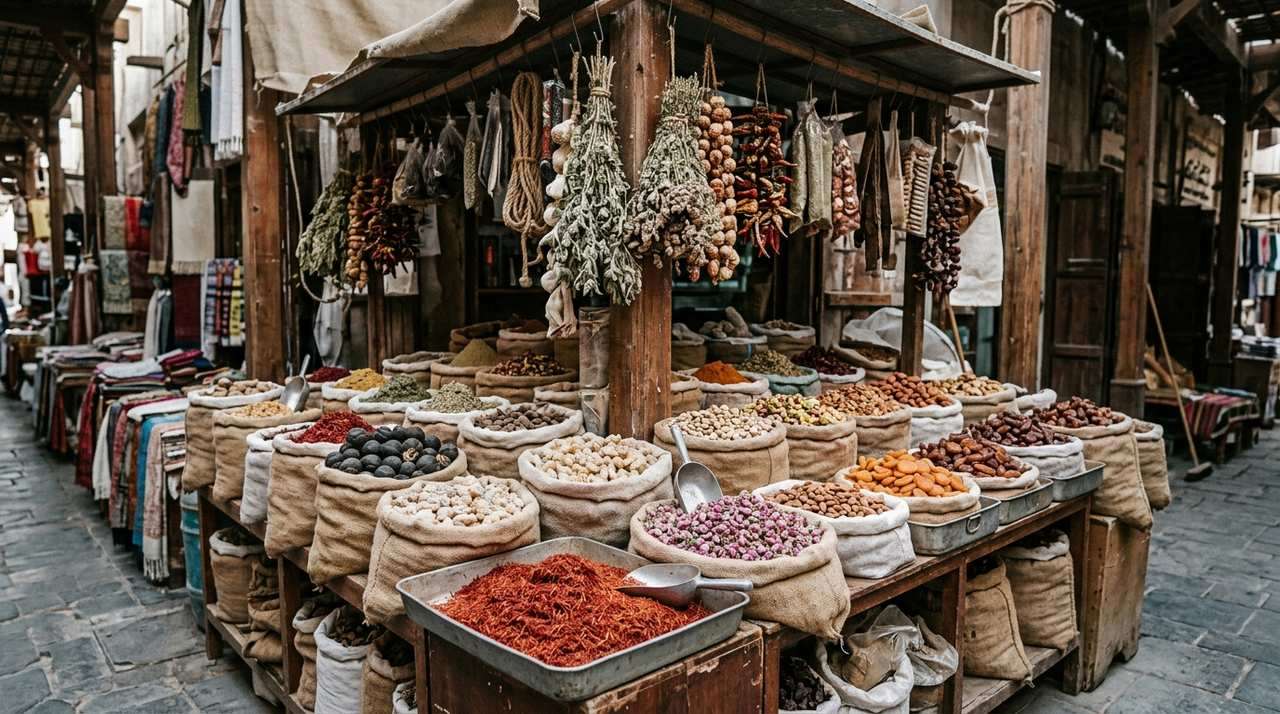
Prices are negotiable and quoted by weight, and the opening number for a tourist is optimistic. Compare two or three stalls before buying anything, especially saffron. Real saffron is expensive everywhere, comes as fine red threads, and is sold in small quantities. If someone offers you a large bag of bright orange strands for a few dirhams, you are being offered dyed safflower.
Across the water, the Textile Souk in Bur Dubai is a covered wooden arcade of fabric, pashmina and souvenir stalls that runs from the abra station towards Al Fahidi. Half of it is genuine cloth trade and half of it is fridge magnets. Walk through it as a corridor rather than a destination, and do not accept the offer to be taken to a "friend's shop" around the corner.
Al Seef is a stretch of the Bur Dubai creek front, built recently in two halves: one imitating old coral-and-wind-tower architecture, one openly contemporary. Purists find it a theme park. In practice it is a pleasant place to sit at sunset with the water in front of you, it has proper cafes and public toilets, and it fills a gap that the historic quarter does not, because the real old town is not built for lingering with a coffee.
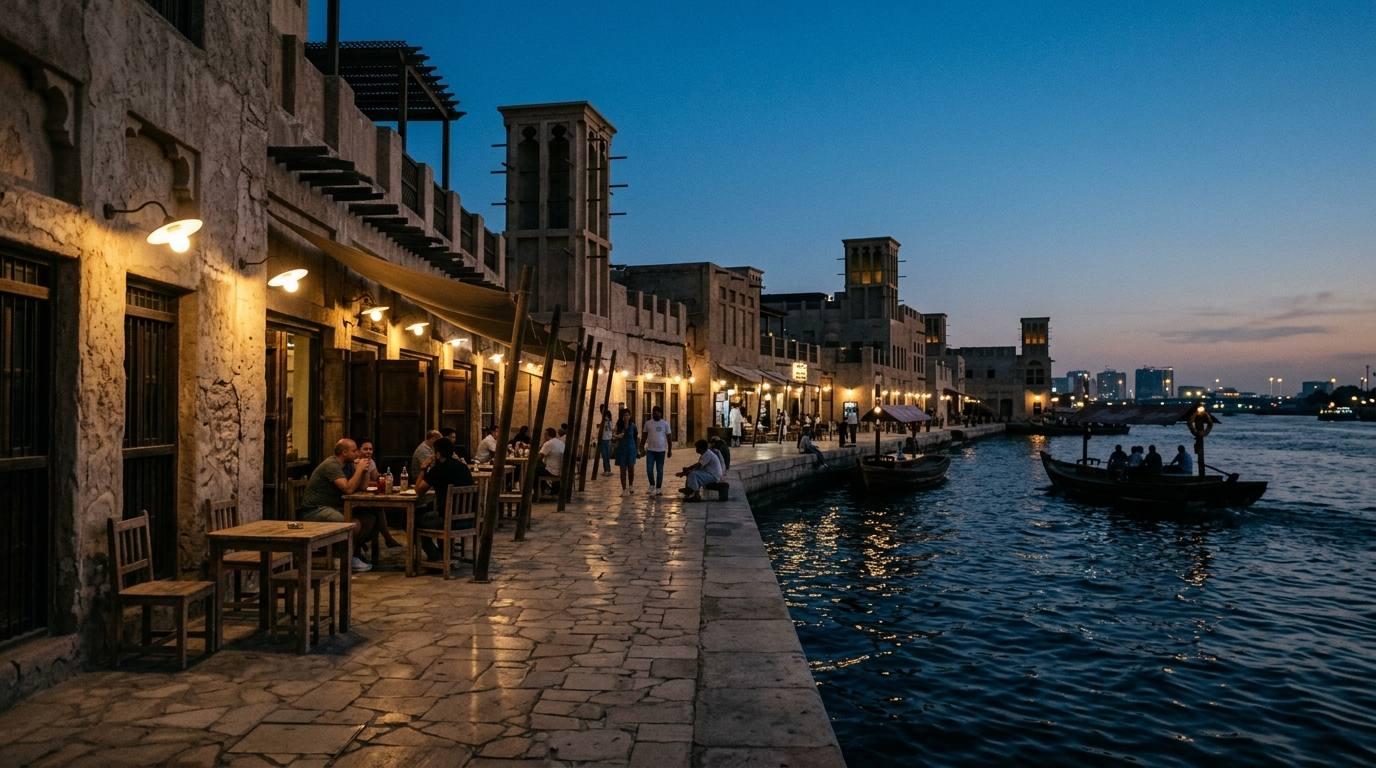
Treat it as an epilogue to the walk rather than a substitute for it.
The Dubai Metro Green Line is the easiest approach from anywhere in the city. Al Fahidi and Al Ghubaiba serve the Bur Dubai side; Al Ras and Baniyas Square serve Deira and the Gold Souk. Both banks are a five to ten minute walk from their stations.
By taxi, ask for Al Fahidi Historical Neighbourhood rather than "old Dubai", which means different things to different drivers, and expect to be dropped at the edge of the pedestrian lanes.
A few things worth knowing before you go:
The cool months between November and March are the obvious window for this walk, for the same reason they are the obvious window for anything outdoors in this city.
Not everything in the area earns your time. The dinner dhow cruises sold from every hotel desk are a slow, buffet-shaped version of a crossing that costs one dirham. The "heritage village" style attractions signposted along the creek are thin. And any shop you are led to by a helpful stranger will be selling at a helpful stranger's commission.
What is worth it: the abra, the wind-tower lanes at Al Fahidi, the Gold Souk as a spectacle whether or not you buy, and the creek at sunset.
Yes, and it is the part of the city most visitors regret skipping. The historic quarter, the two souks and the creek crossing take half a day, cost almost nothing, and are the only place in Dubai where the city that existed before the towers is still visible and still working.
A scheduled abra crossing costs AED 1, paid in cash to the skipper during the crossing. Boats have no timetable and leave when they fill, roughly every few minutes. Hiring a whole abra by the hour costs considerably more and should be agreed before boarding.
Most souk shops open around ten in the morning, close for a few hours in the early afternoon, and trade again until about ten at night. Friday mornings are the quietest time of the week, with many shops opening only after midday prayers.
The gold itself is priced at a daily rate per gram that is identical across every shop, so no seller can undercut another on the metal. The saving comes from low duty and from negotiating the making charge. On plain, heavy pieces that adds up to a genuine discount against European prices; on intricate branded designs it often does not.
Walk from Al Fahidi through the Textile Souk to the Bur Dubai abra station, cross the creek by abra for AED 1, and continue on foot through the Deira Old Souk and the Spice Souk. The whole transfer takes about twenty minutes and is the most enjoyable part of the day.
Yes, and you are expected to. In the Spice and Textile souks everything is negotiable, and the first quoted price to a tourist is well above the sale price. In the Gold Souk the metal rate is fixed, so bargain only over the making charge. Stay polite and be prepared to walk away.
Al Fahidi station on the Green Line is closest to the historical neighbourhood and the Textile Souk. Al Ras station, also on the Green Line, is the closest stop to the Gold Souk and the Spice Souk on the Deira side.
Get an instant summary or ask follow-up questions about this article in your favourite assistant.

UAE Editor at TravelCamel
Daniel moved to Dubai in 2016 and covers attractions, transport and day trips across all seven emirates. His rule for every guide: if a place is not worth the ticket, the guide says so. More guides by Daniel →